The mylz journal

Updates

Our bi-weekly check-ins, archived. Tap any entry to read it. The latest one is open by default.

What's good everyone,

A bit of a late update, but things have been going quite well.

Headspace is getting to a good place. Mylz is moving along nicely. And for those who don't know: Mel (my co-founder, also my wife) is pregnant ๐Ÿผ (due in Nov), which means we're trying to squeeze every last drop out of these next months before mama brain arrives. She's critical to this whole thing, so, priorities (Mylz first, OBVIOUSLY. DON'T WORRY, SHE DOESN'T READ THIS NEWSLETTER).

Training's been good too. I finally found the balance between running and calisthenics + strength + dance (I think...) where my body doesn't feel like death after every run. Central nervous system has finally caught up. It doesn't hurt to run, and we call that a W.

Okay, onto what we've been building ๐Ÿ‘‡

1. The 32g boards showed up ๐Ÿ”ง

Our new accelerometers came in. This is the board we've been waiting on. The bump to 32g lets us capture the harder impacts without clipping, which matters a lot when you're strapping a sensor to a shoe that slams into pavement a few thousand times a run.

The new 32g accelerometer boards, fresh out of the shipping box

We're rewriting the firmware for it now โ†’ once that's done, we can run real testing with real people. Which means I'll be reaching out to some of you personally to help us log some Mylz. Stay tuned ๐Ÿ‘€

2. Scan a shoe, add a shoe ๐Ÿ“ธ

Hardware is slow. Painfully slow next to software. So while we wait on boards, we've been making some dope stuff on the app.

Newest one: instead of hunting for your shoe in a dropdown list, you just point your camera at it and our visual recognition figures out what it is, usually with pretty high confidence. Works on running shoes, works on basically any halfway-popular shoe out there.

Pointing the camera at a shoe to identify it in the app The app recognizing the shoe and adding it to your rotation

3. A bit of external validation ๐Ÿค

Acceptance email from ventureLAB confirming Mylz joined the HardTech Portfolio

We got accepted into ventureLAB's HardTech Portfolio. It's a government-backed program up here, and the pull for us is really two things:

โ†’ The network: investors, hardware people who've actually shipped, advisors, academics. Brains worth picking.

โ†’ The lab: a few million dollars of equipment we get to borrow instead of buy. Better 3D printers for housing prototypes, an x-ray machine to find exactly where our solder joints crack, oscilloscopes to watch our capacitors behave (or misbehave).

Building in a blue ocean means you mostly have to believe in the thing yourself, so a little outside validation feels good.

Anyways. Stay true, stay tough. Talk soon.

Keep logging Mylz, Brian โœŒ๏ธ

Yo! ๐Ÿ‘‹

Say you just got into running and want a new pair of running shoes. You walk into Running Room, the sales associate tells you to walk 10 steps across a foot pressure plate or a foot scanner, and based on those 10 steps they determine the best shoe for you. So what's the point of Mylz? โ†’ That was a couple runners' first reaction when we told them what we're building this week.

Well, here's the thing: walking is not running. It's NOT the same movement at different speeds, it's an entirely different movement. We found that out with our own hardware, and the literature backs it up.

When you walk, you're basically a moving pendulum. One foot is always on the ground, and for about 20% of every step both feet are down at once. Think of it as vaulting over a stiff leg. (source: USPTO)

When you run, you're a bouncing spring. There's a flight phase where neither foot is touching the ground at all, and the leg loads and recoils like a spring instead of a pendulum. The muscles even fire in a different pattern. (source: American Physiological Society)

And the big one: walking lands you around bodyweight, running can spike vertical ground reaction forces up to ~3x bodyweight. Your foot strike often shifts too (heel when walking โ†’ mid/forefoot for a lot of runners). (source: Freedom Clinics)

So here's the punchline ๐Ÿฅ

When a store has you walk a few steps to "test" a shoe, they're measuring the wrong sport. A walk can't show the flight phase, can't show how you land at 3x bodyweight, can't show what your shoe does under actual running load.

It's like test-driving a Porsche 911 GTS by rolling it through a parking lot. You learn that it goes straight (no shit), it turns (it better), the brakes work (WOW!). You learn nothing about how it holds a line through a fast corner, whether the tires actually grip when you push them, or if it stays planted at top speed instead of getting twitchy under hard braking. Everything that defines the engineering, the stuff you actually bought it for, only shows up on the circuit, the sport that it's meant for. The parking lot hides every nuance that matters. A walk test does the exact same thing to a running shoe.

Which is why what we do is a bit more scientific than what Running Room does (oh, we competing ๐Ÿ˜).

Taking it to the labs ๐Ÿ”ฌ

Our goal is to provide the most accurate data within our hardware, with algorithms backed by science. So we've been reaching out to kinesiology profs across Canada to pressure-test our metrics against gold-standard lab equipment, and the response has been better than we hoped.

Email from a York University kinesiology professor inviting us to their lab in August
  • York University (as seen above) got back to us fast and we had a great hour-long call. We've tentatively booked time in their motion-capture lab in August to collect ground-truth data we can tune our algorithms against.
  • McGill hopped on a call and has already been generous with feedback, connecting us with their PhD students for support and steering us toward bilateral asymmetry as the metric to lead with. Which lines up perfectly with our two-tags-per-pair setup.
  • U of T and U Calgary are scheduled for next week.

None of this is us claiming a stamp of approval (we're way too early for that). It's us doing what we know to make sure that when our product says "your left side is working 8% harder than your right," or "your shoe has degraded 5%," that number is backed by reality.

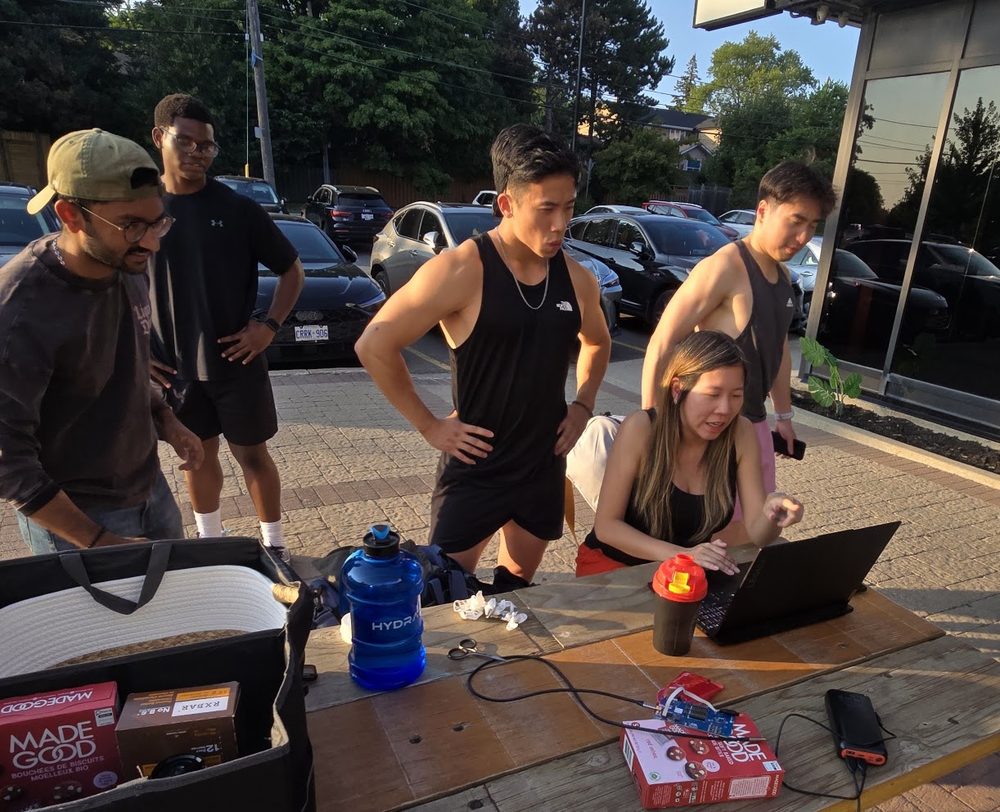
Out collecting gait data on a run More testing footage from the road

More soon. Go run outside, your gait will thank you.

Keep logging mylz, โœŒ๏ธ Brian

Get your head out of the gutter. It's ACTUALLY a physics concept (google it, I promise).

If you ever sat or drove a manual car ๐ŸŽ๏ธ, when there is a bad shift, the car jerks you back and forth. What you're actually feeling is a sudden change in acceleration - that's jerk. And it's something we added to our gait detection algo.

Last update we told you we were jumping to the 32g accelerometer and I questioned the pricing. We're trying to solve both the measurement and the pricing on multiple fronts.

The 32g chip is expensive AF ๐Ÿ’ธ

Like, expensive to the point where it's threatening our whole philosophy: affordable, and PER shoe. The spec sounds fine, the price doesn't.

Two things we're doing about it:

  1. Designing a cheaper accelerometer onto the board. Still 32g, but less resolution, hopefully still good enough for what we need.
  2. Switching the gait detection algo so it can flex across different accelerometers instead of being married to one.

And the experiment underneath all of it: can we get clean step detection at 16g? We still need 32g for the deeper metrics, but 16g is the hard-mode version of the problem. If the algo can nail steps while clipping at 16g, it only gets sharper with the extra headroom at 32g. That's exactly why we added jerk.

Let me get nerdy on how adding jerk affects our algo ๐Ÿค“

Picture the accelerometer as a ruler that only reads up to 16 cm. Sprint hard enough and your foot blows past 16 cm, but the ruler just reads "16" the whole time it's maxed out. Since we'll never know what the max value actually was, our gait detection doesn't work.

We still use this max value, but now with "jerk" we also take into consideration the change from 0 to 16 cm. So when our accelerometer detects a sudden change from 0 to 16, our 2nd layer of gait detection comes through. It doesn't care how big the hit was, only that it happened suddenly. And a footstrike is the most sudden thing your foot does.

The result ๐Ÿ“ˆ

We're sitting at ~90% step detection accuracy for BOTH walking and running. That's progress - one front down ๐Ÿ”ฅ

Step detection accuracy by runner: walking and running steps measured vs actual
Out testing on the road Logging runs around the block Catching data on a walk

We have social media now ๐Ÿ“ฑ

Finally. It's run (GET IT?!) by a friend of ours who's growing his own page, and he's a genuinely dope creator. Go show him some love at @chun.mov.

We're on Instagram and Twitter/X, nowhere else for now. A few early posts are up.

Instagram: @mylz.run Twitter/X: @mylz_run

Go follow, and tell us what you actually want to see on there.

Keep logging mylz, โœŒ๏ธ Brian

The Mylz crew after a run

What's good everyone.

A bit of a late update. Things are slowly moving, but I need your input. ๐Ÿƒ

Brian, mid-run

Y'all know that we swapped the accelerometer. Spec'd the part, finished the design, and manufacturing is on its way.

The catch: it costs more. And parts pricing is genuinely all over the place right now thanks to global supply stuff, so I can't give you an exact number, but estimating roughly $35โ€“40 per pair instead of $30 (and my initial goal of $20 ๐Ÿ˜…).

The goal of Mylz is to track the performance of your shoes. A pair of Mylz lives on your active shoe, permanently, for the life of that shoe. So if you've got 3โ€“4 active pairs in rotation, you're tagging all of them. The real cost is the fleet, not one pair (and no, there's no subscription fee, not for y'all ๐Ÿ™).

So question one, and be real:

At ~$35โ€“40 per tag, living permanently on each of your active shoes, is this worth it to you? "Yes", "no", "maybe...", "depends on what it does," "depends on how accurate it is," "can it make memes?" Tell me which.

(A bit of preamble before the next question.)

Say you're in. What you are currently paying for is:

โ†’ Shoe degradation. The unit metric of Mylz. We watch how your shoe actually dies under your stride and tell you when it's cooked, before your knees send you the invoice. ๐Ÿฆต

โ†’ Running metrics, but per shoe. Cadence, asymmetry, stride length. But what if ... pace can be told as well.

Pace

Since I've been running I've realized how important pace is. So what if Mylz could sharpen what you know about your pace? Right now your Garmin's GPS pace is already solid. But the second GPS gets wonky (indoor track, gym loop, anywhere covered) it's a guess.

So here's question two: what if Mylz could tell you your pace when your Garmin can't? And what if you could see how different shoes affect that pace? That's what Mylz is built to do: tell you how your shoe performs for you. We haven't built pace yet. Not promising it. But would this be interesting? Would you pay even more if it were a core feature?

That's the ask: how y'all feel about the new price point, how y'all feel about more insight into your pace. Holler at me with anything. ๐Ÿ‘Ÿ

Keep running mylz. โœŒ๏ธ Brian

Not "grand"... but 16 times the acceleration of gravity, ~160 m/sยฒ. This is the ceiling of our accelerometer and your foot is faster than that when running!

As y'all know from the last update, our gait detection algo couldn't accurately detect running. Running steps, distance, ground contact time, cadence... anything. Those metrics for walking worked fine, but running fell apart.

We tuned the algorithm โ†’ test it โ†’ nop. Changed thresholds โ†’ test it โ†’ nop. Reordered logic โ†’ test it โ†’ nop. A lot of nops. ๐Ÿซ 

So we went back to fundamentals and measured raw acceleration, hoping it can shine some light. Tbh, I didn't think measuring raw acceleration was this hard.

This was Friday at midnight when we finally got raw acceleration working on our tags:

Friday midnight: raw acceleration finally working

Now that we had raw acceleration... how fast do you think your foot accelerates during a run? Pretty mfing fast. When we selected our accelerometer we picked a 16g one (i.e. it can't measure acceleration greater than 16g) and figured there's no way a foot goes faster than that.

That assumption was wrong ๐Ÿ’€.

We looked at the raw data and were like "oh shit." A massive chunk of the running data was missing after 16g.

So how do we figure out what the actual max acceleration is? How do we even pick a new accelerometer? Well, our phones can measure it. So let's tape one to a foot.

A phone taped to a shoe

Running with the taped-on phone

The funny part? We hit the hard cap on those too ๐Ÿ˜…. Phone accelerometers cap out at 20g, and we were clipping it. Based on our tests, full-sprint acceleration is probably sitting around 21 or 22g.

So now, back to redesigning the board. We're moving the accelerometer up to the 32g tier. New chip, new firmware, and everything else downstream. Needless to say, everything is delayed. We will get a functioning alpha soon! Trust the process!

Heads down, trusting the process

Anyways, I know there's been many races in the last couple of weeks. Proud of ya'll for finishing strong!!

More soon โœŒ๏ธ Brian

Hey Team! ๐Ÿ‘‹

Alrighty, I know the letter is late, but I've been ... running ๐Ÿ˜ฒ

Y'all know that I have never been a runner. It's always lift, sprint, jump, hoops. Then we started to build Mylz. And I should really be my own product's customer ... so bet.

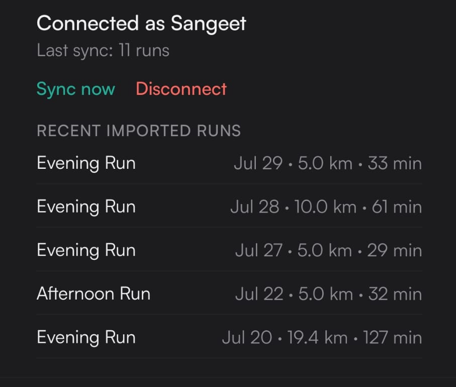
Laced up a new pair of Brooks. 35km across three weeks. Shoutout to @solestop and @fastfoodruns for showing me what run club culture is all about. But... ankles: injured. nervous system: shook. lungs: inflamed. But we are getting data. ๐Ÿ˜…

This is extremely applicable:

Me: "I'm in my prime." My knees: "The fuck you are."

On our product side: we are teaching our tag to detect running ๐Ÿƒโ€โ™‚๏ธ๐Ÿ’€

Nobody tells you about step detection: walking and running feel completely different to a sensor.

Problem 1: the sleepy observer. Imagine your foot is a ball. When you walk, it bounces gently and settles on the ground for a while. When you run, it slams down hard and flies back up in ~200ms. Fast and violent. Our original algorithm was like a sleepy observer. By the time it noticed your foot landed, your foot had already left. Great for walking. Completely blind to running.

Problem 2: counting every step twice. When your car goes over a speed bump, you feel it twice: once for the front wheels, once for the rear. Your foot does the same thing when you run: heel strikes, then toe pushes off. Two sharp signals, one real step. Our tag was counting both. We ran 5,000 steps and logged 13,279. ๐Ÿ˜ฌ

Both are being fixed. Each run gets us closer. ๐Ÿ“ˆ

We are not done. But I am still running. Ankles permitting.

Keep on logging Mylz, Brian โœŒ๏ธ

Run-club love outside SoleStop

Hey Mylz Crew! ๐Ÿ‘‹

I hope your spring training blocks are going strong. We're grinding behind the scenes to get the mylz tag out of the lab and onto your shoes as soon as we can. Though this can feel a bit slow, here are some major steps forward.

  1. New feature: Shoe Degradation Score ๐Ÿ”ฅ After talking to many of you, it was clear: tracking the shoe is what makes mylz different. This is what makes us unique. So we built the Shoe Degradation Score. It takes every metric our tag captures and estimates how your foam and traction are holding up over time, specific to your stride, your weight, your runs.

  2. Hardware v0.2 is working โœ… v0.2 of the hardware uses a production-grade "CPU": more power efficient, more memory, and more economical. The ideal brain. We received the boards last Monday and had to troubleshoot many hardware problems. But as of today, it's WORKING! ๐ŸŽ‰

The new v0.2 hardware, up and running

We're getting closer to launch every single day. Let us know if you want to know anything else.

Keep on logging mylz, Brian

Behind the scenes at the mylz workshop